

A sustainable alternative to cement
Paebbl’s mineralization process yields a mineral filler (comprising magnesium carbonate and silica) that can serve as a high-value Supplementary Cementitious Material (SCM). This raw material can replace up to 30% of traditional, highly CO₂-intensive cement in concrete mortars and prefabricated building elements.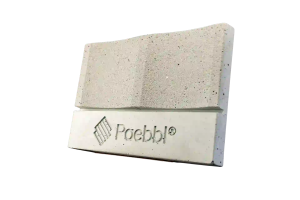
Given that global cement production (4 billion tons per year) accounts for approximately 8% of global CO₂ emissions, this cement alternative provides immense leverage for emission reduction.
Double environmental impact: >100% net-negative CO₂ footprint
Paebbl tackles two massive climate challenges simultaneously. At the core is the reaction of ground olivine (magnesium silicate) with CO₂ to form magnesium carbonate and silica.
This process has a dual impact:
- Active CO₂ storage (Carbon Sink): By reacting CO₂ with olivine, the carbon dioxide is permanently and safely bound in a solid mineral form. Greenhouse gases can never escape again.
- CO₂ avoidance in Construction & Industry: The final product (magnesium carbonate and silica) serves as a high-value Supplementary Cementitious Material (SCM), replacing traditional, extremely CO₂-intensive cement in concrete.
An independent Life Cycle Analysis shows that the process is net-negative by over 100%: even including the energy required for mining, transport, and grinding, significantly more CO₂ is permanently stored and avoided net than is emitted across the entire supply chain.
To scale this technology from R&D to pilot phase, Paebbl worked intensively with Suurmond, a specialist in process technology and supplier of high-quality Büchi pressure reactors. This has enabled Paebbl to build their first demo plant, operating since March 2025.
Vision over real estate: a bold start
When Paebbl was co-founded in 2021 by Pol Knops (now an Advisor with the company) among others, speed was essential. Because specialized pressure reactors are custom-built and certified, the lead time is around one year. Paebbl took a calculated risk: exactly one week after founding the company, they ordered their first Büchi reactors from Suurmond—even though Paebbl only had an office address in the heart of Stockholm at the time.
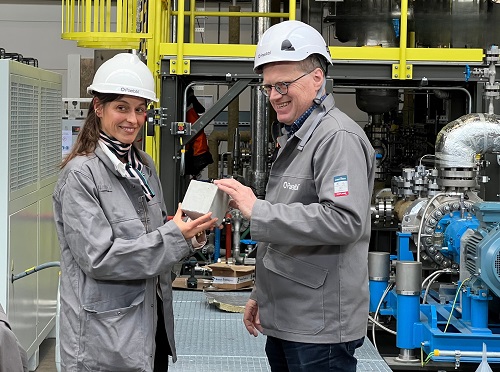
Ana Luisa Vaz and Pol Knops from Paebbl
“We knew the equipment wouldn’t fit in our Swedish office,” says Pol Knops. “But since Suurmond and Büchi needed a year for construction and certification, we gave ourselves exactly one year to find the ideal location.”
By the time the equipment was ready, the new lab in Rotterdam was set up. This proactive approach allowed Paebbl to launch straight into R&D and produce test samples for the European construction sector.
The reactor arsenal: from R&D to pilot production
Paebbl uses a varied arsenal of reactors, given distinctive nicknames by the team:
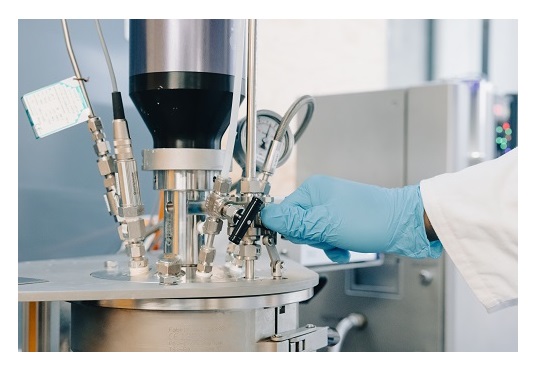
- R&D: The ‘Coffee Cups’ (5L)
The extremely compact ‘coffee cups’ and the 5-litre Büchi pressure reactor (versoclave type) are used for fundamental process research. Here, researchers test the exact influence of temperature, pressure, additives, residence time, and raw materials.
- Pilot Plant (500L): ‘Obelix’
The 500-litre Büchi pressure reactor (Pilotclave type) is the largest in its class. This unit is dedicated purely to production: with it, Paebbl supplies substantial quantities of SCM material to cement and concrete manufacturers for Paebbl’s firsts pilot projects.
Knowledge transfer and custom engineering
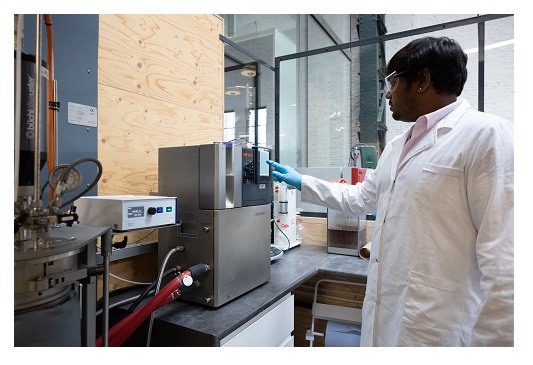
High-end equipment requires solid expertise. Prior to Paebbl, Pol Knops had already worked with Büchi reactors at RWTH Aachen. When process engineer Vignesh Kumar Prabakaran joined Paebbl to manage the reactor systems, he spent his first working week in Aachen. In this way, years of academic practical knowledge were directly transferred, allowing Vignesh to commission the installation in Rotterdam quickly and safely.
Pioneering with abrasive slurries under high pressure
Processing an olivine slurry under elevated pressure and temperature places heavy demands on equipment; abrasive particles can quickly erode valves and seals. Suurmond provided more than just the Büchi hardware; they actively contributed to the overall process design—from integrating thermostats to hydraulic lift systems and wear-resistant dosing and discharge valves.
The result? To this day, the reactors operate without wear or leakage.
Towards industrial scale
Thanks to the combination of robust Büchi technology and Suurmond’s tailored engineering, Paebbl has proven its process technology in a short space of time. Using the SCM material produced at Paebbl R&D centre in Rotterdam, the first climate-positive concrete projects have been realized with customers.
In March 2025, Paebbl transitioned from batch to a continuous process again on a bigger scale, with their demo plant.
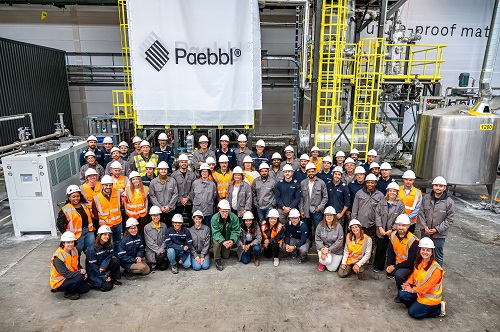
Team Paebbl anno 2026
Suurmond supplies solutions to optimize your process and improve the quality of your end-product. Our specialists will be happy to advise you.