

How flexible glass reactors accelerate your scale-up with less maintenance and higher output?
In the competitive world of Contract Development and Manufacturing Organisations (CDMOs), the transition from grams to kilograms is a critical phase. How do you ensure your reactor configurations are flexible enough to switch rapidly between projects without compromising on quality or safety?
The answer lies in modular glass reactors and innovative connection technologies.
The Challenge: Why is traditional scale-up often slow?
Several bottlenecks frequently occur when scaling up chemical compounds for toxicological and clinical studies:
- Rigid connections:
Traditional glass setups are often difficult to adjust, resulting in hours of ‘trial and error’ during configuration changes. - Corrosion and resistance:
Metals and certain plastics are prone to corrosion, while not every type of glass can withstand thermal shocks. - Strict regulations:
Equipment must comply with stringent Good Manufacturing Practice (GMP) standards and be easy to validate.
The Solution: Maximum flexibility with Büchiflex components
To overcome these challenges, the market is increasingly turning to modular systems from Büchi.
What makes these systems unique for scale up?
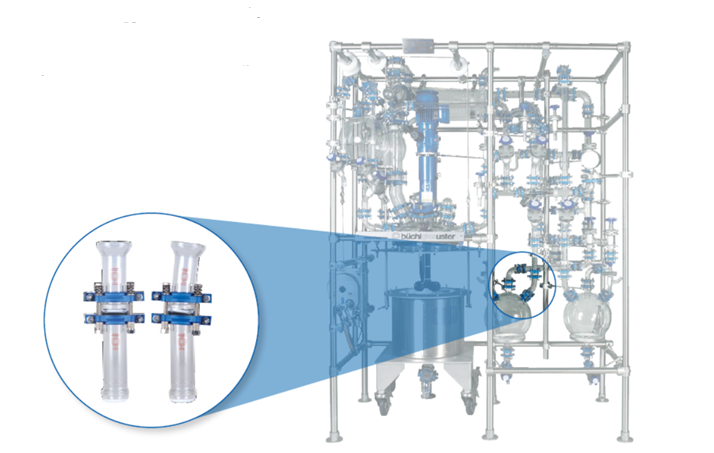
1. The büchiflex flexible ball-and-socket system
The core of a flexible setup is the connection between the glass components. The unique büchiflex system, where each glass component features a ball-and-socket joint, offers significant advantages:
- Stress-free assembly:
By using metal rings with springs, the components align perfectly without subjecting the glass to excessive tension. - No compensators required:
The inherent flexibility of the couplings eliminates the need for additional bellows or compensators in the glass assembly. - TÜV-certified:
The connections are guaranteed to be airtight and leak-free. - Simple component exchange:
You can carry out modifications yourself, instantly.
2. Rapid configuration changes with Camlock
Beyond the glass connections themselves, peripheral equipment plays a major role in process speed. By using anti-static PTFE hoses with Camlock couplings, glass equipment can be swapped out quickly and easily.
This significantly reduces downtime between different batches.
Why choose glass reactors for scale-up?
Glass remains the preferred material for many pharmaceutical applications due to several specific properties:

- Visual control:
Borosilicate glass allows chemists to visually monitor the reaction and crystallisation processes. - Inert and easy to clean:
Glass provides a smooth surface that is highly resistant to aggressive environments and simple to clean—crucial for the purity of the final product. - Thermal stability:
High-quality glass is exceptionally resistant to heat and thermal shock.
Conclusion for your process
Successful scale-up in a GMP environment requires equipment that adapts to your needs. By investing in modular glass reactors with flexible couplings, you lower maintenance costs, reduce the required inventory of spare parts, and can respond more quickly to market demand.
Would you like to know how a modular reactor setup can optimize your R&D or kilo lab? Suurmond supports you in the design and implementation of durable, configurable solutions from Büchi.